
What an Oakland County Arrest Record Shows
An Oakland County arrest record starts at the moment a person is booked into the Oakland County Jail or a city lockup. The Sheriff's Oakland County Jail page describes the intake area on the first floor as the place where new arrests are processed, with holding tanks and observation cells for 109 inmates. A booking record typically lists the person's name, date of birth, booking date and time, charges, arresting agency, bond, and a current custody status. The Oakland County jail intake handled 12,247 prisoner admissions in 2024.
The arrest record itself is separate from the court record that gets created when a prosecutor files charges. The booking shows what police said happened. The court file shows what the prosecutor and the court did with the case. For Oakland County, the court file lives in the 6th Circuit Court for felonies, in a district court for misdemeanors and felony preliminary examinations, and in Probate Court for related juvenile or mental health matters. See court records for the full Court Explorer walkthrough.
Search the Oakland County Jail Roster
The Oakland County Sheriff links the CLEMIS Inmate Locator from the Sheriff's homepage and the jail page. The portal sits at apps.clemis.org/ClemisInmLoc. Users must clear a Google reCAPTCHA and pick Oakland County Jail before the search runs. The page below is the live CLEMIS landing screen used for an Oakland County arrest records search after a recent booking.
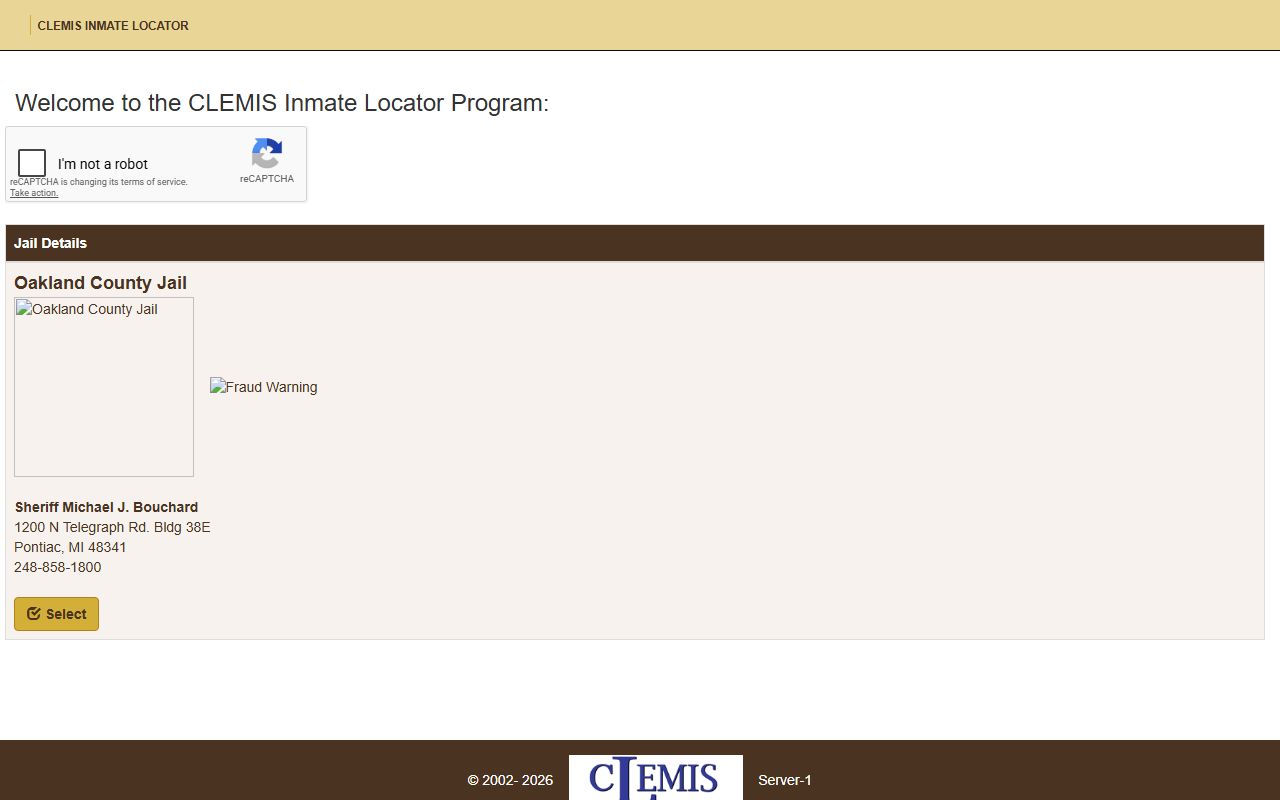
The Sheriff's CLEMIS portal disclaimer warns the inmate information is presented without warranties as to accuracy, timeliness, or completeness. The jail page says charge or bond details may be up to 72 hours out of date depending on the day of the week. For charge or bond questions, contact the court of jurisdiction. For inmate information, call 248-858-1800 or email prisonerinfo@oakgov.com. The inmate records page has the full step-by-step lookup walkthrough and the CLEMIS field inventory.
Arrest Record vs Criminal Court Record
Two different files matter after an arrest in Oakland County. The first is the Sheriff or police arrest record. The second is the court case file. Each one is created and maintained by a different office, and each one shows a different part of the story. The table below explains how the two records line up.
| Arrest Record | Criminal Court Record | |
|---|---|---|
| Created by | Arresting police agency and the Oakland County Sheriff's intake | 6th Circuit Court for felonies; district court for misdemeanors and preliminary exams |
| Main contents | Booking, charges as filed by police, arrest report, mugshot, bond at booking | Complaint, warrant, charges, plea, sentencing, judgment, register of actions |
| Where to search | CLEMIS Inmate Locator and the Sheriff's Records Unit | Court Explorer for Circuit cases; the local district court for misdemeanor and traffic cases |
| Public | Public unless restricted by court order or juvenile rule | Public unless restricted by statute, court rule, or sealing order |
Charges vs Convictions
A charge is what the police or prosecutor say a person did. A conviction is a guilty plea or guilty verdict that has been entered as a judgment by the court. Many Oakland County arrest records list charges that never end in a conviction. Cases are dismissed, charges are amended, juries acquit, and prosecutors decline to file. Background checks and news stories often mix the two up. The court file is the source of truth on the final outcome.
| Charge | Conviction | |
|---|---|---|
| Stage | Filed by police or prosecutor at the start of the case | Entered after a guilty plea or guilty verdict |
| Public access | Generally public in the court file when filed | Public in the court file unless set aside |
| Effect | Triggers court process, bond, and arraignment | Triggers sentencing, possible jail or probation, and reporting to MSP |
| Set-aside | Not an issue; charges that did not result in a conviction can be dismissed or expunged separately | Eligible convictions can be set aside under MCL 780.621 or by Clean Slate under MCL 780.621g |
Michigan State Police ICHAT
For a statewide criminal history, the official source is the Michigan State Police Internet Criminal History Access Tool, called ICHAT, at michigan.gov/msp/services/chr. MSP describes ICHAT as a public criminal history record search for felony and serious misdemeanor data required to be reported to the state by law enforcement, prosecutors, and courts. The fee-based name-based search returns a state-level record but does not include warrants, federal records, tribal records, traffic records, juvenile records, local misdemeanors, or suppressed records.
ICHAT is the official statewide criminal record check. Oakland County Court Explorer is not. The Clerk's Court Explorer page warns the data is not the official court record and should not be used as a criminal background check. For an Oakland County employer or background-screening use, ICHAT or a fingerprint-based MSP search is the right starting point. A fingerprint-based Personal Record Check carries a $30 fee, and an application-based set-aside carries a $50 fee, per the MSP's conviction set-aside page.
Sheriff's Records Unit
The Oakland County Sheriff's Records Unit handles incident reports, traffic citations, inmate jail files, gun registration, and FOIA requests. The office is open 8:30 a.m. to 5:00 p.m. and asks walk-in fingerprint clients to arrive before 4:30 p.m. Incident reports are not always available right after an arrest; many are held while the case is active. Once a case is closed or the report is releasable, the Records Unit fills the request.
Local police arrests by city, township, or Michigan State Police follow that agency's own records request process. The Sheriff handles county and unincorporated patrol arrests and jail records. For a recent arrest by a city police department, contact that city's records or FOIA officer.
Bond, Warrants, and Arraignment
After an Oakland County arrest, bond is set by the court of jurisdiction, not by the Sheriff. The Sheriff's jail page says the Bonding Area runs 24 hours a day and accepts Regular, Surety, Interim, and Fines and Costs bonds continually. Cash bonds of $10,000 or more are processed at the court of jurisdiction. Bonds may be paid at the jail with cash, credit card, or cashier's check made out to the Oakland County Sheriff's Office, or through a bail bondsman. The jail does not accept Bitcoin or any cryptocurrency.
If a person is arrested on a warrant, the warrant came from a court. The court of jurisdiction handles arraignment, bond, and scheduling. The 52-3 District Court page says walk-in arraignments are Monday through Friday from 9:00 a.m. to 10:30 a.m. or from 1:00 p.m. to 3:00 p.m., with check-in at the Clerk's Office. For a known warrant before an arrest, see the warrant records page for the resolution steps.
Sealed vs Expunged
Sealed and expunged records are different things in Michigan. A sealed court record is kept on file by the court but with public access blocked, usually by court order under MCR 8.119. An expunged or set-aside conviction is made nonpublic for many purposes under Michigan's set-aside law in MCL 780.621 and the Clean Slate automatic process in MCL 780.621g.
| Sealed | Expunged / Set Aside | |
|---|---|---|
| How it happens | Court order to limit public access in a specific case | Application to the convicting court or automatic Clean Slate process |
| Record exists? | Yes, on file with limited access | Yes, but nonpublic for most uses |
| Law enforcement access | Allowed in many cases | Allowed; law enforcement and courts keep access |
| Driving record | Not affected directly | Set-aside under MCL 780.621c does not always clear the Secretary of State driving record |
Restricted Arrest Records
Some Oakland County arrest and criminal records do not appear in any public search. Juvenile records are restricted under MCL 712A.28 and are not in Court Explorer. Probate Mental Health records are excluded from Court Explorer. Sealed cases are blocked from public access. Set-aside convictions become nonpublic. Active investigation files and unserved warrants are also not in the public record while the case is open.
Note: ICHAT does not include warrant data, traffic records, juvenile records, federal records, or suppressed records, so it cannot be used to confirm an active warrant or a pending federal matter.
Prosecutor and Public Defender
Karen D. McDonald is the Oakland County Prosecutor. Her bio page says she was elected on November 3, 2020 and took office on January 1, 2021. The Prosecutor's Office is at 1200 N. Telegraph Rd, West Wing - Building 14E, Pontiac, MI 48341. Phone is 248-858-0656, email is prosecutor@oakgov.com, and the office is open Monday through Friday from 8:30 a.m. to 5:00 p.m. Her early initiatives included a Trafficking Unit, a Hate Crimes Unit, and the Oakland County Conviction Integrity Unit.
For appointed defense in Oakland County, the Indigent Defense Services Office covers the 6th Circuit Court and the four divisions of the 52nd District Court. Contact IDSO at idso@oakgov.com or 248-452-9396, Monday through Friday from 8:00 a.m. to 4:30 p.m. The Oakland County Public Defender's Office uses a hybrid assignment model with Chief Public Defender Paulette Loftin and is reached at publicdefender@oakgov.com or 248-424-7033.
Specialty Courts and Criminal Records
Oakland County runs several criminal specialty programs that can change how an arrest case moves through the system. The 6th Circuit Adult Treatment Court is a post-adjudication program for non-violent felony defendants with substance use or co-occurring mental health and substance use issues. The Combat Veterans Treatment Court works with eligible U.S. military veterans on probation.
At the district court level, the 52-1 District Court in Novi runs Drug Court, Sobriety Court, Veterans Court, Mental Health Court, and Community Courts. The 52-4 District Court in Troy runs a Drug Therapy Court. Each program ties into the court file, so an arrest record connected to a specialty court case may include compliance hearings, drug-test entries, and graduation orders that look different from a standard criminal docket.